A Low-Key Evening Reset After a Change in Routine
A low-key evening reset after a change in routine helps you mark the shift from day to night, set up one useful detail, and leave the rest alone.
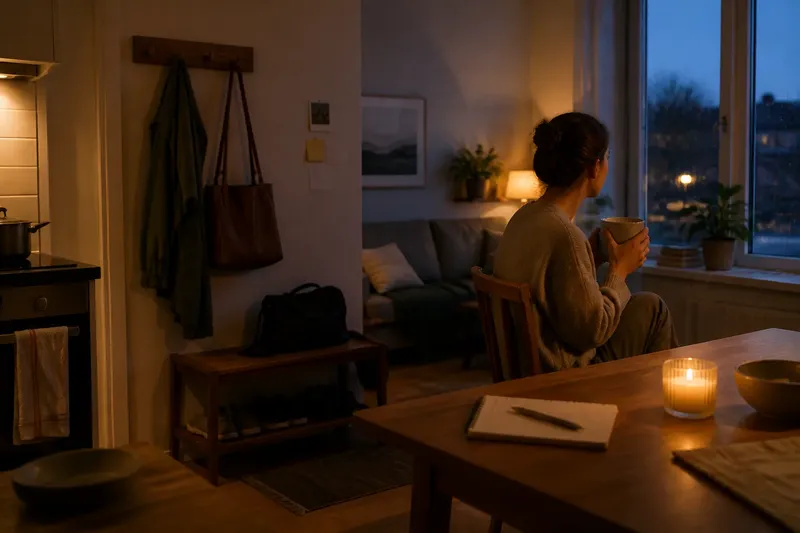
The bus pulls in late, dinner lands on the table after dark, and the usual evening has vanished. A low-key evening reset after a change in routine can mark the shift from doing to resting without requiring you to rebuild the schedule. Think of it as closing the day’s door gently, not tidying every room before you leave.
What should an evening reset change?
A changed routine can make the evening feel unfinished. Perhaps a new commute has pushed dinner later, a guest is sleeping in the living room, or a work shift has rearranged the hours you used to keep. The old sequence may no longer fit, and forcing it back into place can make a tired night feel like another assignment.
Instead, focus on the transition itself. Notice what still needs attention, what can wait, and what would help you feel that the day is ending. That might mean rinsing your dinner plate, changing into comfortable clothes, or closing the laptop and moving it off the table.
A reset does not need to make you feel calm or productive. It only needs to help you stop carrying the entire day into the next hour.
How can you mark the shift into evening?
Choose an action that makes sense at the point where your day actually changes, rather than at a fixed time on the clock. If you arrive home late, it might be putting your work bag in its usual place. If you finish a shift at home, it might be closing the work tab and turning your chair away from the desk.
Keep the action tied to the evening you have. A cup of tea can be a cue to sit down, but it need not be part of a longer sequence. A quick change of clothes can help separate work from home, even if dinner still needs making and the kitchen is untidy.
Say your commute changes and you now walk in while a pot of pasta is boiling. You could set your bag beside the door, turn off work notifications, and eat before deciding whether anything else needs doing. The observable result is a clear boundary around the workday; if an urgent responsibility remains, you can handle that without reopening every task from the day.
Choose a transition you can do without preparing for it. If it adds more work, it is the wrong size for tonight.
What can wait until tomorrow?
Some tasks need attention before bed; many simply remain visible. A damp towel, an unread message, and a stack of mail can all look like unfinished business without being urgent. Ask what has a real deadline or safety concern tonight, then leave the rest for a more suitable time.
If you are worried about forgetting something, write a brief reminder for the moment it matters. “Reply to Maya after lunch” gives the task a place to land without making you rehearse it in your head. Put the note where you will see it at that time, or use a reminder tool you already rely on.
- If a cooking appliance is still on, turn it off and check that it is safe before moving on; if you cannot confirm it, follow the appliance instructions or ask for help.
- If medication or another time-sensitive responsibility is due tonight, follow its instructions; if you are unsure what to do, ask a qualified professional rather than guessing.
- If a message has a genuine deadline before morning, send the necessary reply; if it can wait, note when you will return to it.
- If a wet item needs attention to prevent a problem, handle that specific item; if it is only untidy, leave it for later.
- If tomorrow’s appointment requires a document or key, put that item with what you will take; if plans are uncertain, leave the usual place clear and check in the morning.
- If a household closing task is required for safety or shared responsibilities, do that task; if it is only a preference for a tidy room, let it wait.
The distinction is between necessary care and the urge to make every visible thing disappear. Stop when the real deadline is covered.
How can you make a little room for quiet?
Quiet does not have to mean silence, meditation, or a room arranged just so. It can be a small stretch with fewer demands: sitting at the kitchen table after clearing a place for your cup, eating without a screen, or listening to rain at the window.
Match the pause to the conditions around you. If the house is busy, try the front step or a quieter corner. If silence makes you feel more alert, put on familiar music or a radio program rather than searching for the perfect sound.
Pick one option, then let it be enough. You do not have to empty your mind or produce a particular feeling.
What if the evening keeps changing?
What if I do not know what tomorrow looks like?
Leave the evening focused on what is true now, such as putting your wallet in its usual place or closing the workday. If a specific preparation would depend on plans that are still uncertain, wait until you know more.
What if I am too tired to do anything?
Skip the reset and rest, or let the transition be as small as changing into sleep clothes. A tired evening does not need another task to count as finished.
Should I repeat the same evening routine every night?
Keep only the parts that still suit the evening. A familiar drink or a quick change of clothes may fit, while a fixed sequence may not.
What if a quiet pause makes me more unsettled?
Try gentle movement, such as rinsing a cup or putting away one item, instead of sitting still. If distress feels intense or persists, consider contacting someone you trust or a qualified health professional.
How do you keep an evening reset from becoming a chore?
Give it a natural stopping point. You might stop after putting your bag away and deciding what can wait, or when you finish your drink. The goal is not to complete a set of steps; it is to let the day loosen its grip.
If you notice yourself adding rules, delaying rest until the room is perfect, or judging your choices, make the reset smaller. One boundary between work and home may be enough. On a late-shift night, the whole transition might be changing clothes and going straight to bed.
A low-key evening reset after a change in routine works when it responds to the evening in front of you. Mark the shift, handle what truly cannot wait, and leave the rest alone. If the most useful choice is sleep, let the day end there.
Tomorrow’s plans may change again. Keep any note or prepared item only if it still helps; otherwise, move it aside and let the next evening have its own shape.