The Personal Letter as a Practice of Attention
A personal letter practice can turn a half-formed thought into a clear note for one reader, with a simple process for drafting, revising, and choosing whether to send.
You find an old recipe card in a kitchen drawer, its corner stained with tomato sauce, and think of the friend who gave it to you. A personal letter practice can turn that stray prompt into a note with a clear purpose, rather than another message typed and forgotten between errands.
The useful part is not paper or handwriting by itself. It is making a small piece of communication deliberate: deciding what belongs in the note, what should stay private, and whether the other person needs a reply right away.
What should a personal letter do?
Choose one job for the note before you begin. That gives the page a boundary and helps you avoid trying to retell your whole life at once.
- Share an update: If you have one event the reader would recognize or care about, describe that moment and why it stayed with you; if nothing feels worth sharing, write about a routine change or wait until another prompt appears.
- Say thank you: If you can name what the person did and how it affected you, include both; if the thanks concerns something private, keep the detail general and express the appreciation without exposing it.
- Reconnect: If you have a genuine question about the person’s life, ask one; if you are tempted to send a string of questions, choose the one you would most want to answer yourself.
- Work through a difficult thought: If the note is mainly for your own clarity, keep it as a draft; if the person needs to respond or make a decision, choose a conversation or another direct channel.
- Offer encouragement: If you can point to a specific effort or quality, name it; if you do not know what the person needs, avoid prescribing a solution and offer your presence instead.
- Mark an occasion: If a short greeting would feel natural, keep it brief; if the relationship is distant or complicated, use a simple, respectful message rather than assuming a level of closeness that is not there.
One purpose is enough. You can write another note later.
Should you write by hand or type?
Handwriting suits a note when the physical form adds something: a card tucked into a book, a recipe annotation, or a few lines that the recipient can keep. Use a pen that writes clearly and paper that is easy to fold. There is no need to make the page ornate.
Typing is often more comfortable if handwriting is tiring, hard to read, or inconvenient. Email also makes sense when delivery matters or the recipient prefers it. A letter’s care comes from the choices in its wording, not from the tool used to compose it.
Imagine you want to thank a former neighbor for lending you a book. Your starting inputs are the title, the fact that she lent it, and your response to one scene. You draft: “Thanks for lending me the book. The chapter set in the train station made me think about our long waits for the late bus. I hope your garden is settling in.” Then you remove the bus reference if it feels too private, keep the thanks and book detail, and choose email because you do not have her current mailing address. The resulting note is specific without requiring a grand story, and the format fits what you know.
How can you draft and revise a personal letter?
Use a short sequence that leaves room for judgment rather than forcing a polished performance:
- Choose the recipient and purpose. Write their name and a few words such as “thank,” “update,” or “check in.” If the purpose takes a long paragraph to explain, narrow it before drafting.
- Gather one concrete starting point. Use a shared memory, a recent event, an object, or an action you appreciate. If the detail feels private or uncertain, replace it with a safer one.
- Draft the message plainly. Say what happened, what you think or feel about it, and why you wanted to tell this person. If a sentence sounds unlike you, rewrite it in your ordinary speaking voice.
- Check what the note asks of the reader. If you need a prompt reply or a serious discussion, use a channel suited to that exchange; if no reply is needed, make that clear or close naturally.
- Decide whether to send. If the note is kind, clear, and appropriate to the relationship, choose a delivery method; if it feels exposing, pressuring, or unfinished, keep it as a draft and revisit it later.
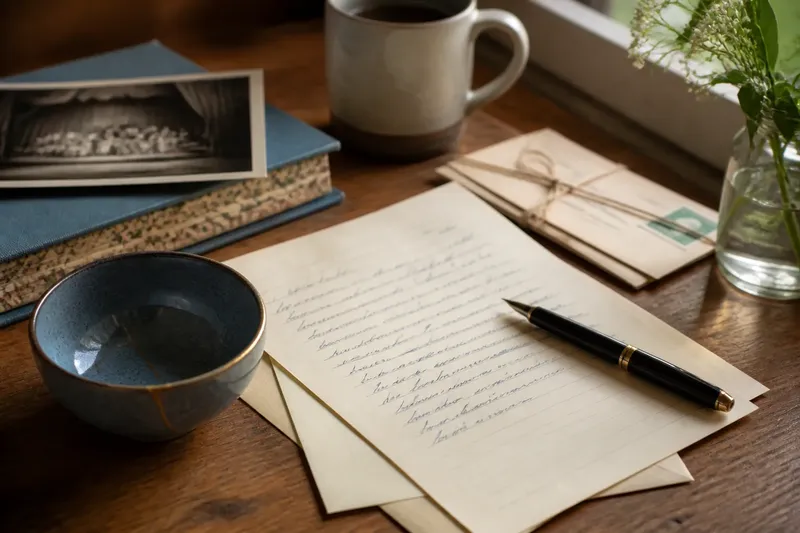
For example, say you want to reconnect with an old classmate. Your starting inputs are a photograph from a school play, your memory that you both forgot a line, and uncertainty about whether the classmate welcomes contact. You write a short draft naming the photograph, mention the missed line without claiming to know how they feel about the memory, and ask whether they would like to catch up. You reread it and remove a second question about their family because it feels too personal for a first note. The result is a low-pressure invitation; if you still feel unsure about sending it, the draft can remain unsent.
What should you write when you have little time?
Try a compact shape: one detail, one sentence about its meaning, and one line for the reader. A note about a chipped blue bowl might say that it survived another move, remind you of the person who found it at a yard sale, and ask whether they still collect mismatched dishes.
If you cannot find a detail, do not invent significance. A straightforward greeting or a brief thank-you can be enough. The point is to communicate honestly, not to make an ordinary day sound profound.
Which personal letter questions come up often?
What do I write about if nothing unusual happened?
Choose a routine detail, such as a meal you made or a book you picked up, and say why you thought of the recipient. If no detail feels natural, a simple greeting is better than dressing up a story.
How do I keep a letter personal without oversharing?
Share only what you are comfortable having the recipient read and keep. If a detail involves someone else’s private information, leave it out or describe the situation more generally.
Should I send a letter I wrote to sort out my feelings?
Not necessarily. A private draft can help you clarify what you want to say without making the recipient responsible for your first reaction; if a response is needed, choose a direct conversation or another suitable channel.
When is a text better than a letter?
Use a text for urgent logistics, a quick question, or a conversation that needs a prompt reply. A letter fits better when you want to offer a considered message without requiring an immediate exchange.
How can you close the note naturally?
End with a line that fits the relationship: a question about the book they mentioned, a wish for their upcoming move, or your usual sign-off. You do not need to summarize the note or add a dramatic final thought.
Keep a few cards with your everyday supplies, or save a blank email draft for later. The personal letter practice is most useful when it makes communication easier to begin: choose one purpose, write what you can stand behind, and let the recipient decide how to respond.